G.P.O.
712L / 722
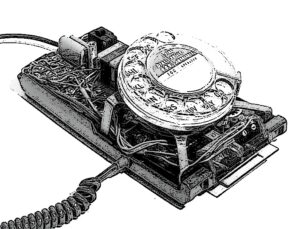
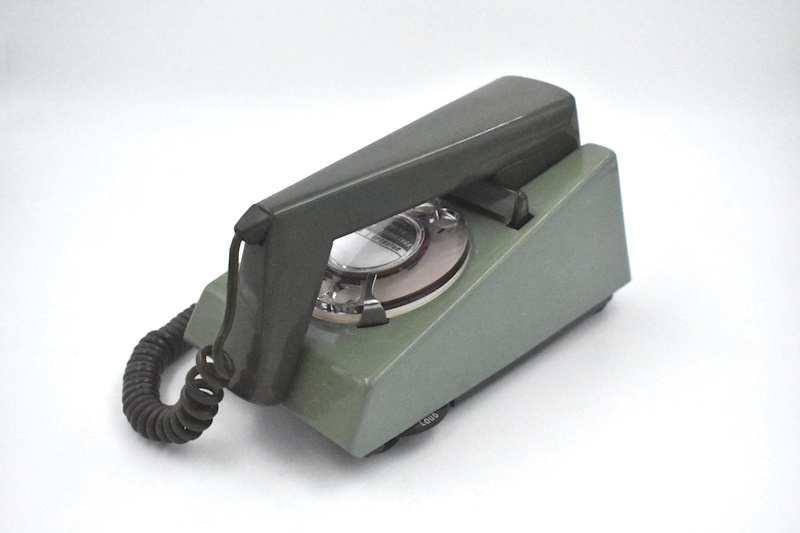
The Trimphone was a telephone device designed in the early 1960s in Great Britain, with the first prototypes appearing in 1965 by the General Post Office (G.P.O). The name is an acronym for Tone Ring Illuminator Model, referring to the new electronic ring tone and illuminated dial. The illuminated dial, also known as the betalight, contained the radioactive element tritium. There was concern about the luminescent dial glowing green in the dark. This effect came from a small glass tube of tritium gas, which emitted beta radiation and caused the dial to glow slightly. It was eventually withdrawn due to continued concerns from subscribers. The innovative designer of Standard Telephones and Cables, known as STC, Martyn Rowlands won an award from the Design Centre in 1966. In 1964, the General Post Office signed a contract for 10,000 sets. The Trimphone began operation in 1964 as telephone number 712. The Trimphone was the first G.P.O. telephone to use a dial tone ringing at approximately 2,350 Hz. The ringing volume gradually increased over the first few cycles. Another problem was its light weight, around 800 grams. This was compared to the 700 series phones which were 1.5 kg and around 2.5 kg for the 300 series. On slightly sloping or shiny surfaces the device would slip when making a call. After a series of modifications, the final version of the Trimphone was the 2/722 which was introduced in 1971. The first version of the Trimphone with a keypad appeared in 1977. The first design of the Trimphone with a keypad to achieve large-scale production was the SC version Tele 766. This design incorporated relays, but did not require batteries. In 1979 an MF4 (Touch-tone) design was introduced to replace the bulky coils and capacitors of the previous models and the model’s name TELE 786. The next version of the Trimphone was the Deltaphone, a luxury version with a leather case. In 1980, after 15 years of operation, it needed a refresh to keep up with the competition. The reincarnation was a collection of telephones in alternative color schemes called the Phoenix telephone or the ”Snowdon Collection” with a dial and keypad. British Telecom, or BT, as the General Post Office had now been renamed, fitted them with the new plug-socket connection and they were available for sale. The colors of the 712 and 722 models were: blue, green and grey. The colors of the Snowdon collection were: the olive handset and beige handset, the dark orange handset and orange handset, the dark red handset and red handset, the black handset and grey handle, the light green handset and mint green handle and finally the brown handset and ivory handle. The first trimphones were manufactured at the STC factory in Larne, Northern Ireland. They were also manufactured by GEC-AEI Telecommunications in Newton Aycliffe, County Durham (code GEN) and at the G.P.O factory in Cwmcarn, Wales (code FWR). In Greece, very few devices of this type appeared commercially and from those who happened to travel to England.Its dimensions are W:10.8cm x D:21.6cm x H:11.4cm.