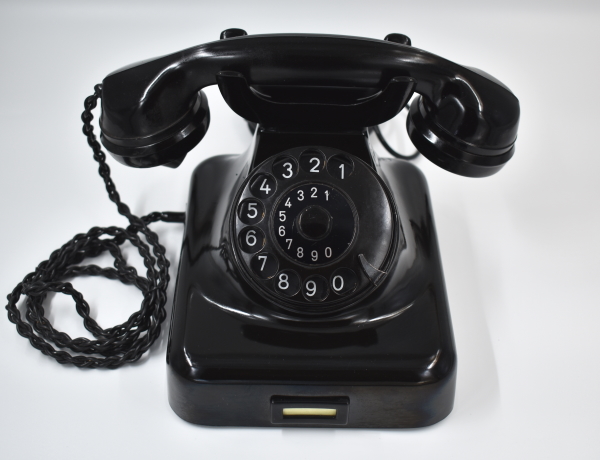
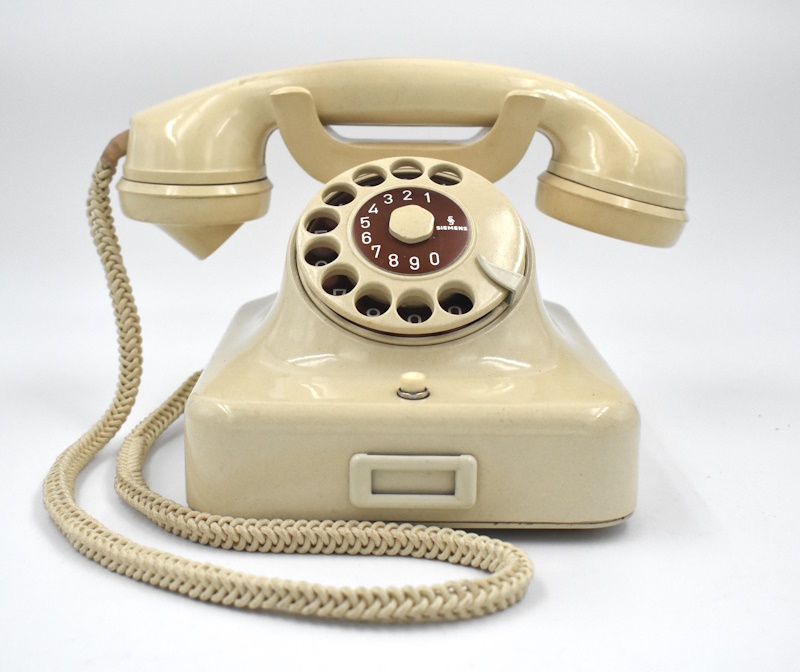
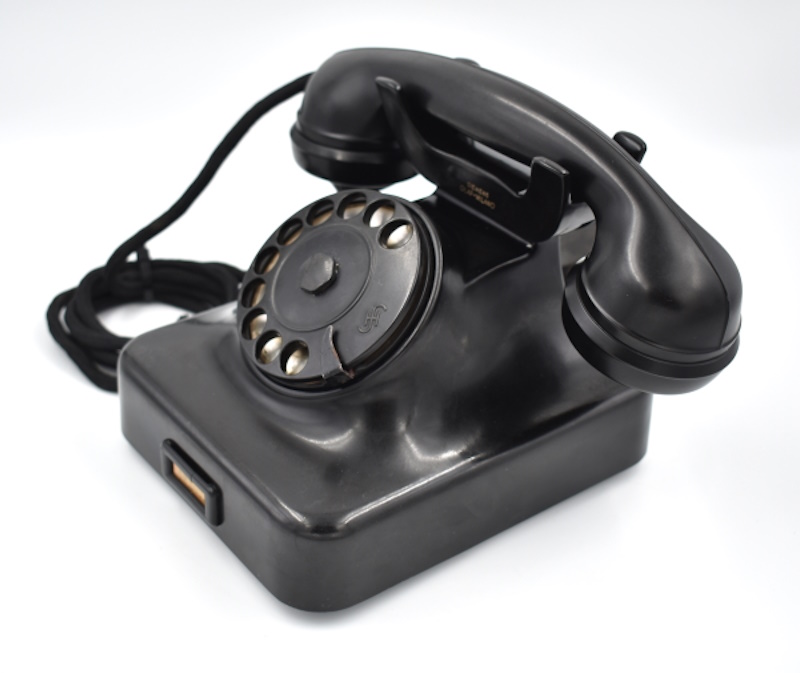
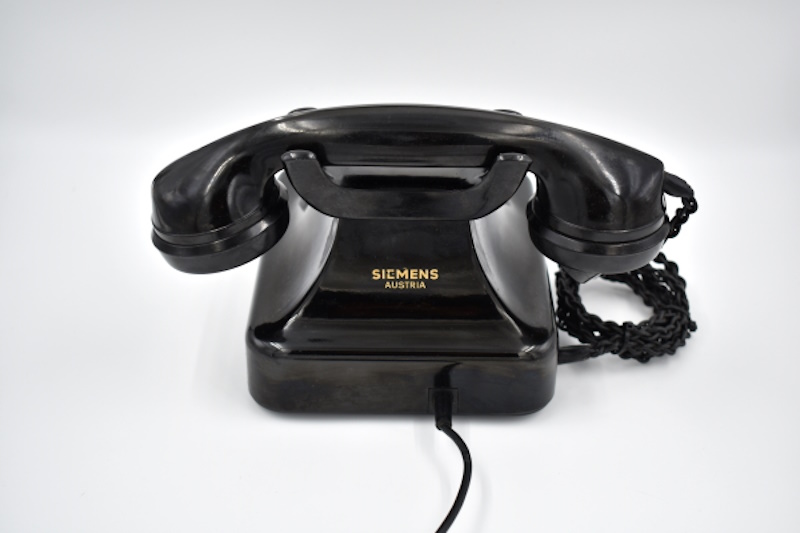
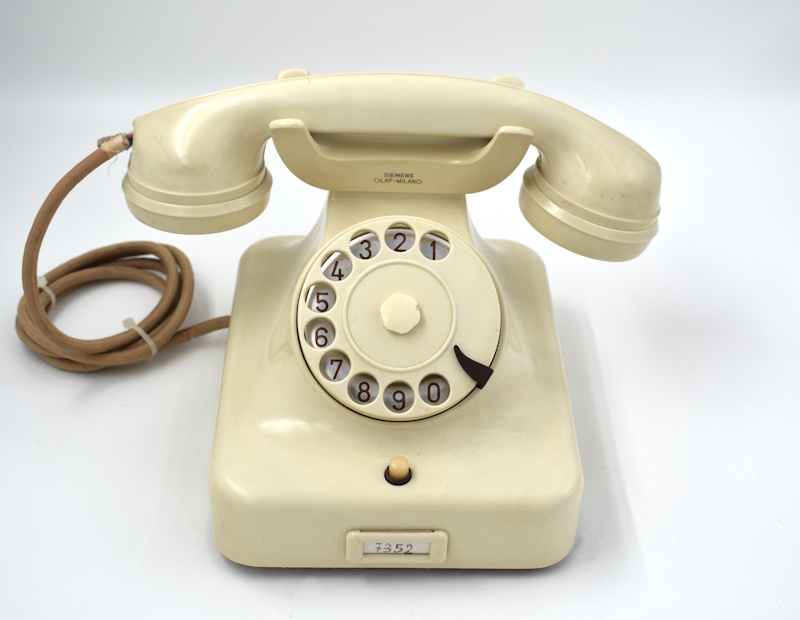
In the mid-1930s, the German Post, Deutsche Reichspost commissioned Siemens & Halske to design a new model to replace the W28 phone. Siemens has been conducting extensive testing since 1934, testing new types of materials, molds and manufacturing processes. In 1936, he finally introduced a model based on this research to the public at the Leipzig Spring Exhibition. The requirements in detail: a numerical switch with a forced pause between the digits formed so that, for example, the quick selection of an “11” cannot be misinterpreted as a “2”, since both would produce two identical pulses. The German Post Office did not approve the model and thus never became a “W 36”. The correct name is therefore “model 36”, Siemens & Halske model numbers “fg.tist.166” and later “fg.tist.221”. Belgium also manufactured W36 with number Fg Ms 54 S 253 on behalf of the Netherlands. Siemens continued to produce the device for private telephone systems until about 1950. In the 1940s there were occasional copies of Siemens & halske’s Model 36, in which both the disc number and the perforated one were made of black painted black zinc. There is also an ivory version of the Model 36 with a brown numbered perforated and a brown numbered disk. However, we do not know the production period and the country of manufacture (Germany or Austria). Model 36 was manufactured both with and without ground where required. Although the model 36 resembles the W 38 and its successors the W 48 is not identical in construction. Externally, the Model 36 can be quickly recognized by the non-centrally connected connection cable, which goes farther left. The side edges of the seat operate exactly at right angles to the table in model 36, while in successive models they are slightly upwardly curved. In addition, the base plate is not flat with the seat as in successive models, but protrudes underneath so that it can see the edge of the base plate. Surprisingly, leaving the base plate for the successors, the lower end housing material became thinner and therefore more susceptible to breakage. As with the W 38, the handle has a funnel-shaped microphone cap in two parts. The interior differs significantly in the layout of the same fittings from the successive models. As already mentioned, successive models of the Model 36 are not identical in manufacture, but most fittings and connecting cables between the 36, W 38, W 48 models can be replaced as desired – except for the switch and the terminal block. There are no structural differences between the individual components. Electrical components may vary in shape and size, as well as the type of “packaging”, especially brown in the case of paper, less often in cream color due to different manufacturers and years of manufacture, but the function and pin assignments always remain the same. . In some pre-war models of the W 38, as well as in many post-war productions, round capacitors were installed. The same is true of W 38, which continued to be built in the GDR after the war, and its slightly modified successors, the W 48 in the Federal Republic. At that time, by necessity, all existing spare parts were assembled on new devices regardless of the model series and standards. This has sometimes resulted in variants of the 36, W 28 and W 38 models. Most of the time, the capacitor markings and thus the year have been removed. The base plates were often fitted with new holes to be able to combine a W 38 housing with the model base plate 36. These improvisations are available from Siemens, from VEB Fernmeldewerk Nordhausen (both with ID: fg.tist.221b), and from Austria (fg.01.tif.066). Although the W 38 replaced the 36 in 1940, Mix & Genest in Germany and Siemens & Halske in Germany and Austria did so again shortly after the war. In Austria, the Model 36 was built in the 1950s by the nationalized Wiener Schwachstrom-Werke (WSW) for private telephone systems. Spare parts were still sold to wholesalers in 1960.